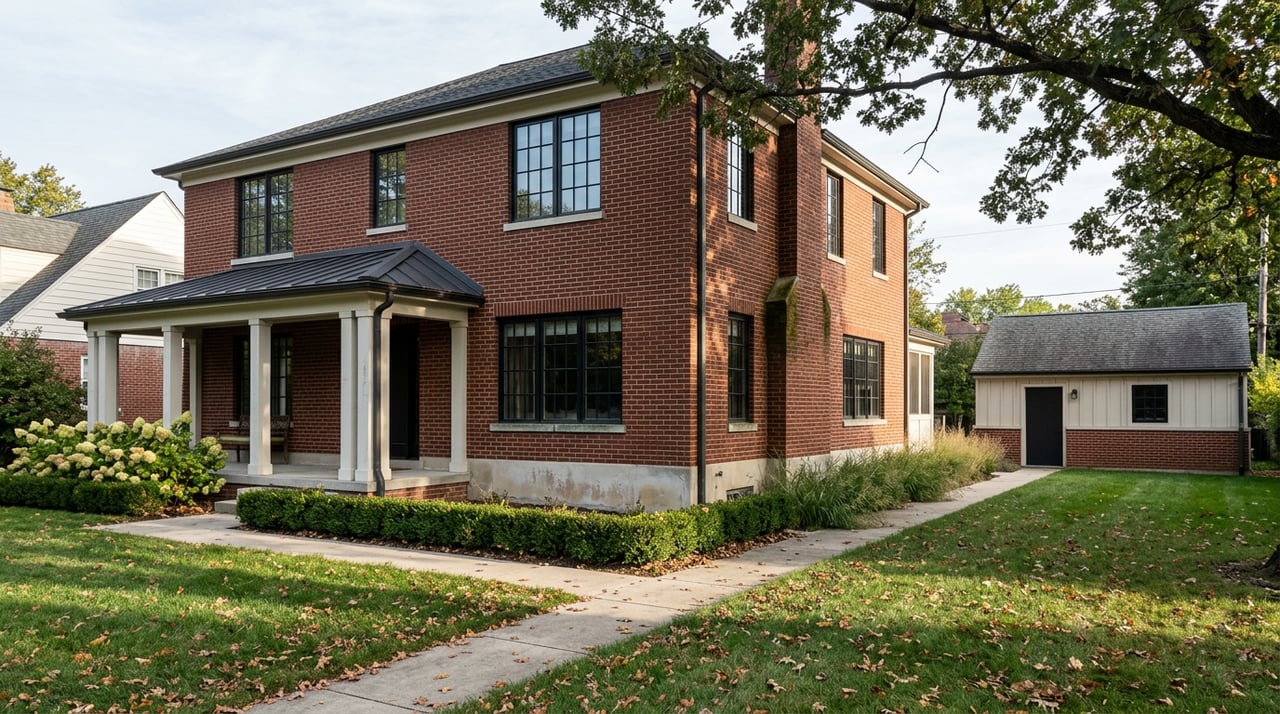
Evanston's Zoning Code Is Being Rewritten Right Now. Here's What Buyers Need to Know.
September 24, 2026
September 24, 2026
Walk two blocks in Evanston and two blocks in Wilmette, and the houses might look interchangeable. Similar lot depth, similar 1920s brick, similar asking price. But the zoning underneath those two lots is not the same kind of thing right now, and it will not necessarily be the same kind of thing in five years. One town's rulebook is stable. The other's is being rewritten in real time, with a state legislature circling overhead threatening to rewrite it faster and further than the city itself has proposed.
If you're comparing Evanston to the rest of the North Shore, that difference is worth understanding before you write an offer, not after.
Start with what's already true, because it's the part most out-of-town buyers miss entirely. Evanston has an accessory dwelling unit ordinance. This isn't a future policy. It's current code. ADU Zoning lists a maximum size of 1,000 square feet for Evanston ADUs.
The practical numbers, based on current permit and market data:
It's also a useful baseline for the next section, because everything else in this post is about how much further Evanston might go.
On January 26, 2026, Evanston's City Council adopted a new comprehensive plan for the first time in over a quarter century, voting 5-4 along a clear split. The plan is called Envision Evanston 2045, and among its stated goals is a directive to expand by-right residential development, including small-scale multi-unit housing in all residential districts. In plain terms: the city's own long-range policy document already says it wants to expand housing options across residential districts.
Adopting a comprehensive plan doesn't rewrite the actual zoning code by itself. It sets the policy target that a separate, more technical zoning rewrite has to follow. That rewrite is now underway, and the timeline is longer than most buyers would guess.
| Milestone | Target |
|---|---|
| Comprehensive plan adopted | January 26, 2026 |
| Zoning consultant selected (Code Studio) | August 2026 |
| Preliminary zoning concepts released | Q1 2027 |
| Full draft zoning code | Late 2027 |
| Final adoption, if on schedule | July 2028 |
The city hired Code Studio over a competing firm, McKenna, at a contract price of $911,480, roughly $540,000 more than McKenna's bid, in exchange for a more thorough public engagement and drafting process. If the current schedule holds, Evanston won't have a finished replacement for its existing R1 and R2 rules, which Evanston Now reports currently require minimum lot sizes of 7,200 and 5,000 square feet respectively, until the second half of 2028.
That's the part worth sitting with. A buyer closing on an Evanston home this fall is buying under today's rules. A buyer who plans to hold that same property for five years or more is buying into a zoning code that is scheduled to be replaced sometime between the two.
Evanston's own process isn't the only variable. In February 2026, Governor JB Pritzker announced a statewide package called the Building Up Illinois Developments plan, or BUILD, aimed at preempting local zoning restrictions to expand housing supply across Illinois. One piece of the package, filed as SB 4060, would have allowed multi-unit "middle housing" statewide on a sliding scale: up to four units on lots between 2,500 and 5,000 square feet, six units on lots up to 7,500 square feet, and eight units on anything larger, regardless of what local zoning currently allows.
City staff confirmed that roughly 95 percent of Evanston's residential parcels are larger than that 2,500-square-foot threshold. Had BUILD passed as written, nearly every residential lot in the city would have opened to multi-family use overnight, well ahead of anything Evanston's own zoning rewrite has proposed.
It didn't pass. The package never reached a floor vote in either chamber before the spring 2026 session ended June 1, largely due to opposition from the Illinois Municipal League over the plan's preemption of local zoning authority. But the governor's office has said the plan isn't dead, just delayed. As Capitol News Illinois reported, the governor's director of housing solutions, Olivia Ortega, said during Senate testimony:
"Our current rules make it very difficult to build the homes people need, and that is what BUILD is designed to address."
Pritzker has said he intends to bring the plan back during this fall's veto session, which means the question of whether the state overrides Evanston's own multi-year process is genuinely unresolved as this is being written.
None of this means Evanston is a risky place to buy, and it doesn't mean the character of any given block is about to change overnight. City review timelines, the Land Use Commission process, and the sheer scale of a 2028 target date all argue for a slow, incremental shift rather than a sudden one.
What it does mean is that the assumption you'd bring to a purchase in most of the North Shore, that the zoning designation on the listing sheet is close to the zoning designation you'll live under for the next decade, doesn't hold the same way in Evanston right now. If you're evaluating a lot for its teardown or infill potential, the honest way to model it is against a moving target: current R1 or R2 restrictions as the floor, the existing ADU ordinance as context, and a wider set of possibilities on the table by 2028 depending on how both the city's rewrite and the state legislature land.
For a family buyer prioritizing stability, that uncertainty might be a reason to ask more questions about a specific block's zoning district before writing an offer. For an investor or a multi-generational household looking at long-term flexibility, the same uncertainty might be the more interesting story.
Either way, the zoning line on an Evanston property isn't a fixed fact the way it is almost everywhere else nearby. It's a live process, and it's worth treating it as one.
Does Evanston's current R1 or R2 zoning still apply to homes for sale today? Yes. The comprehensive plan adopted in January 2026 sets policy direction, but it doesn't change the zoning code itself. Current lot size minimums in R1 and R2 districts remain in effect until the zoning rewrite is drafted and formally adopted, which isn't targeted until mid-2028 at the earliest.
What size limit applies to an Evanston ADU? ADUs can be up to 1,000 square feet. It's worth confirming the specifics for a given parcel with the city's planning department before budgeting a project.
Could my Evanston lot legally hold more units by the time I'm ready to sell? Possibly, but it isn't settled. The city's own rewrite process points toward allowing more small-scale multi-unit housing, though the final code isn't expected until 2028. Separately, a stalled statewide plan in Springfield could move faster if revived this fall. Either path would need to run its course before anything changes on paper.
Zoning questions like these are exactly why a local read matters more than a national headline. If you're weighing an Evanston property against other North Shore towns, or trying to figure out what a specific lot's zoning district actually allows today, the Geoff Brown Team can walk through the parcel-level details with you and help you build a purchase decision on what's actually true right now, not what might be true in 2028. Reach out for a free home valuation and a straight answer on what your lot can and can't do.
This article is general information, not legal, tax or financial advice. Consult a qualified professional about your situation.
Stay up to date on the latest real estate trends.
With personalized strategies and unmatched local insight, the Geoff Brown Team ensures every client’s transaction is smooth, successful, and stress-free.